
MVV achieves solid earnings and reports growing volume of investments in the energy transition
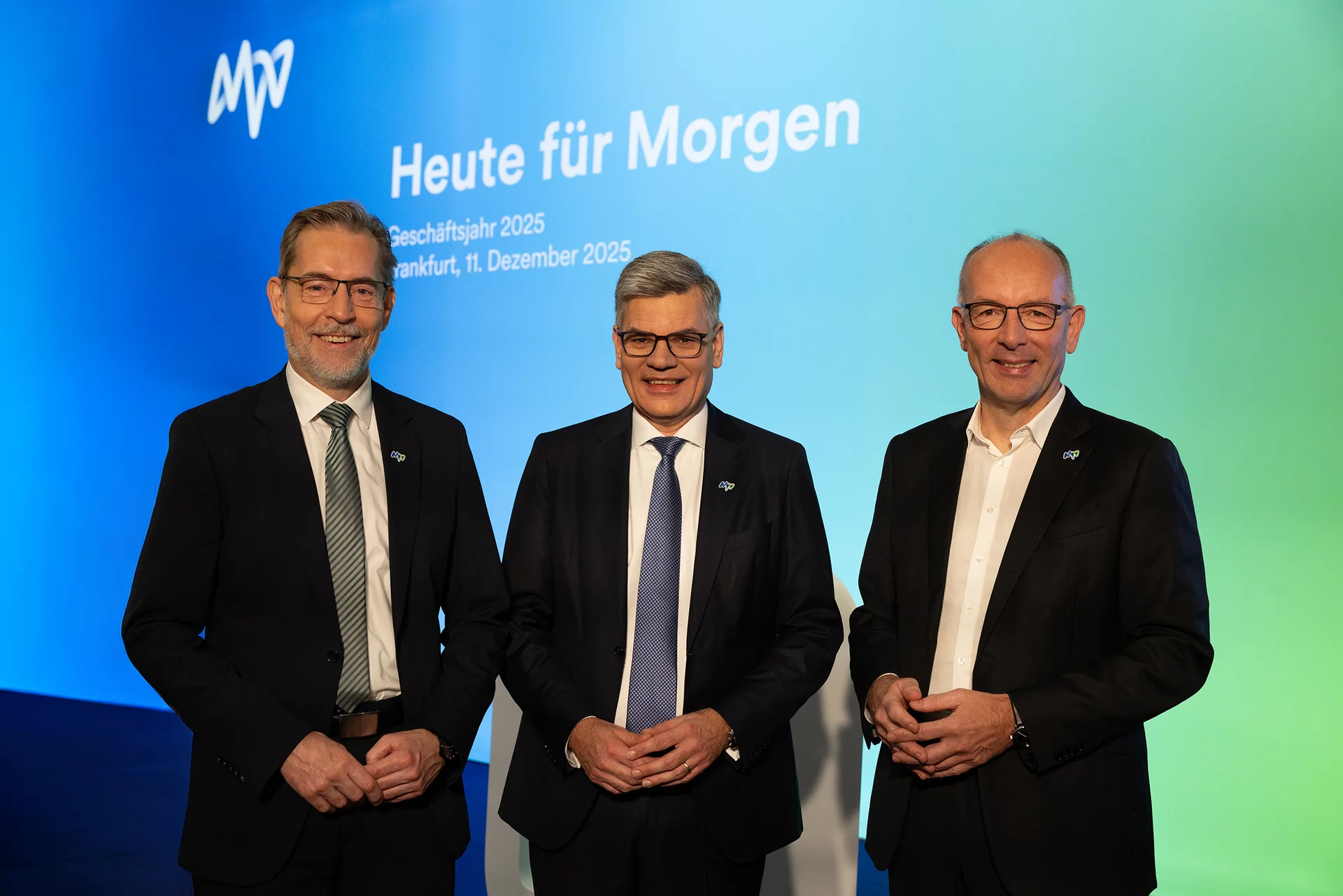
The Mannheim-based energy company MVV Energie AG (ISIN: DE000A0H52F5, WKN: A0H52F) has posted solid financial results despite operating in a challenging environment. Although lower wholesale prices meant that MVV’s adjusted sales of Euro 6.1 billion for the 2025 financial year (1 October 2024 to 30 September 2025) fell short of the previous year (Euro 7.2 billion), the company achieved adjusted EBIT of Euro 360 million. “Given the demanding market climate, we can be satisfied with these earnings”, commented Dr. Gabriël Clemens, Chief Executive Officer of MVV Energie, when presenting the annual results.
It was true that earnings were lower than in the previous year (Euro 426 million), but that had been expected and forecast from the outset, stressed Clemens: “A variety of one-off factors led to exceptionally strong earnings in 2023 and 2024. It was clear to us that these factors would not be repeated.” In addition, MVV posted lower earnings in its project development and environmental energy businesses, as well as due to lower wind volumes. By contrast, earnings contributions had developed positively in the Generation and Grids business fields. Particularly when viewed over a longer period, the CEO added, it was apparent how positively the results for the 2025 financial year could be assessed: “Apart from the ‘one-off years’ of 2023 and 2024, long-term comparisons show that these are very good earnings. Our broad-based business model again proved its worth. We owe the strong results for 2025 above all to the dedication of our staff, who now number more than 6,800 and each day channel their energies into advancing MVV”.
Adjusted net income after minority interests stood at Euro 171 million in the year under report and thus fell Euro 62 million short of the previous year’s figure. A dividend of Euro 1.30 per share, corresponding to an increase of 5 cents per share compared with the previous year, will be proposed for approval by the Annual General Meeting in March 2026.
Turning to the current financial year already underway, MVV expects above all to generate lower earnings contributions in its trading business and its Generation and Grids business fields. Moreover, the company continues to feel the effects of customers’ reluctance to invest. Overall, MVV therefore expects to generate adjusted EBIT of between Euro 200 million and Euro 240 million in the 2026 financial year.
High level of investment
MVV reported a growing volume of investments in the 2025 financial year, with a total of Euro 501 million – Euro 84 million more than in the previous year – being channelled into projects promoting the heat transition, electricity transition and green customer solutions. This is one of the highest volumes of investment in the company’s history.
Key focuses of these investments included expanding green heat in Mannheim, building windfarms and a solar park and taking these over into MVV’s portfolio. In addition, MVV invested in expanding, maintaining and modernising its distribution grids.
“With this high level of investment, we are underlining the goal we have set ourselves of continuing to implement the transformation in the energy supply along the lines set by our Mannheim Model, i.e. focusing on the heat transition, electricity transition and green customer solutions”, explained the company’s CEO. MVV expects a significantly higher volume of investments in the current financial year.
Further advancing the energy transition
As part of the heat transition, a second MVV river heat pump with thermal capacity of up to 165 megawatts is currently being built on the site of the large power plant Grosskraftwerk Mannheim. This facility, from a current perspective the largest of its kind in the world, is set to launch operations in winter 2028 and then supply climate-friendly heat to up to 40,000 further households. To make district heat in Mannheim and the region fully green, MVV is also planning a third river heat pump and to draw on regional geothermal energy. GeoHardt GmbH, a joint venture between MVV and EnBW, announced a first location for a geothermal heat plant in mid-November. MVV is converting to climate-friendly heat generation based on large-scale heat pumps in Offenbach and Kiel as well. In Offenbach, these will use waste heat from data centres, while Kiel plans to use water from the firth. It is also planned to connect the coastal power plant (Küstenkraftwerk) in Kiel to the core hydrogen grid.
The electricity transition is also progressing, with new windfarms in North Rhine-Westphalia, Saxony-Anhalt and Rhineland-Palatinate and a solar park in Baden-Württemberg extending MVV’s proprietary renewable electricity generation portfolio. These projects are the result of development activities at MVV’s Juwi subsidiary. Furthermore, MVV is pressing ahead with expanding its grids to safeguard supply reliability in the changing energy system. Measures here include building a substation to connect to the transmissions grid in the Rhine-Neckar region and expanding the high-voltage grid in Offenbach.
Largest single investment in company history
MVV is also setting standards in the circular economy. Here, a new energy from waste plant is being built in Wisbech in south-east England. At around half a billion euros, this marks the largest single investment in MVV’s history. The plant will incinerate around 625,000 tonnes of non-recyclable waste a year and use this to generate climate-friendly electricity for around 150,000 households and in future to supply companies with steam.
Innovative solutions for real estate and charging infrastructure
MVV is also promoting the energy transition with individual customer solutions ranging from heat pumps and climate-friendly combined solutions to e-mobility charging infrastructure through to complex energy concepts. One current example is a project being realised for STRABAG Real Estate in Hamburg. Here, MVV is implementing a sustainable heat and cooling supply for a large office complex based on a smart holistic concept involving ice storage, heat pumps, cooling equipment, solar power and district heat.
One special milestone in e-mobility is the new charging park for electric trucks at Mannheim’s commercial port, which is due to launch operations at the beginning of 2027. This will provide four fast-charging points, including one charging point with a capacity of up to one megawatt. Together with the port company Staatliche Rhein-Neckar Hafengesellschaft Mannheim and the City of Mannheim, MVV is promoting the electrification of heavy goods transport and developing the port into a sustainable transport hub.Overall, MVV currently operates 609 charging points at 251 locations.
Politicians called on to create stable underlying conditions
The energy industry is under pressure. Geopolitical conflicts, trade barriers and political changes are exacerbating the situation on international markets. In parallel, the energy transition is entering a phase in which retail customers are assuming a more central role. “Now, individual customers have to decide how to heat their homes in future, how they want to help generate the electricity they use and what drive system they prefer for their cars”, explained the company CEO. “Particularly in this phase, it is important for the sustainable energy supply to find a balance: between climate protection, economic viability and supply reliability. This can only work based on broad acceptance within society, built on reliability, fair conditions and social compatibility. Here, everyone is called on to play their part.”
Reliability and plannability are crucially dependent on the political and regulatory framework. “For the heat sector transformation, the EU Gas Directive has to be swiftly implemented in national law. After all, grid operators can only act if a clear legal framework is in place. It is a good sign that the Federal Government already initiated the relevant legislative proceedings in 2025”, commented the company CEO. He also welcomed the adoption by the Federal Parliament of the German Geothermal Energy Acceleration Act (GeoBG) at the beginning of December. With regard to the electricity sector, Clemens called for a gradual transition in the renewable energies subsidy regime. Any abrupt change would threaten further expansion. To provide certainty for existing and future projects, the Federal Government should also avoid sudden changes in its forthcoming amendment to the German Building Energy Act (GEG).
“We will be maintaining our #climatepositive course, even in difficult times. Our broad-based business portfolio makes us resilient. And we are investing today in tomorrow’s energy supply, which will be climate-friendly, reliable, affordable and accepted by customers”, remarked Clemens in conclusion.
The complete Annual Report is available on the internet at mvv.de/investors.
MVV in Figures
| Financial key figures | FY | FY | % |
|---|---|---|---|
| Sales and earnings | |||
| Adjusted sales excluding energy taxes (Euro million) | 6,083 | 7,194 | – 15 |
| Adjusted EBITDATooltip (Euro million) | 586 | 633 | – 7 |
| Adjusted EBITTooltip (Euro million) | 360 | 426 | – 15 |
| Adjusted annual net incomeTooltip (Euro million) | 233 | 281 | – 17 |
| Adjusted annual net income after minority interestsTooltip (Euro million) | 171 | 233 | – 27 |
| Capital structure | |||
| Adjusted total assets at 30 SeptemberTooltip (Euro million) | 5,971 | 5,947 | 0 |
| Adjusted equity at 30 SeptemberTooltip (Euro million) | 2,633 | 2,526 | + 4 |
| Adjusted equity ratio at 30 SeptemberTooltip (%) | 44.1 | 42.5 | + 4 |
| Net financial debt at 30 September (Euro million) | 1,139 | 926 | + 23 |
| Cashflow and investments | |||
| Cash flow from operating activities (Euro million) | 462 | 498 | – 7 |
| Investments (Euro million) | 501 | 417 | + 20 |
| Value performance | |||
| Adjusted ROCETooltip (%) | 9.8 | 12.5 | – 22 |
| WACC (%) | 8.1 | 8.6 | – 6 |
| Value spread (%) | 1.7 | 3.9 | – 55 |
| Adjusted capital employedTooltip (Euro million) | 3,692 | 3,411 | + 8 |
| Share | |||
| Adjusted earnings per shareTooltip (Euro) | 2.60 | 3.53 | – 26 |
| Regular dividend per share (Euro) | 1.30Tooltip | 1.25 | + 4 |
| Non-financial key figures | |||
|---|---|---|---|
| Direct CO2 emissions (Scope 1)Tooltip , Tooltip (tonnes 000s) | 2,326 | 2,589 | – 10 |
| Indirect CO2 emissions (Scope 2)Tooltip , Tooltip (tonnes 000s) | 111 | 128 | – 13 |
| Indirect CO2 emissions (Scope 3)Tooltip , Tooltip (tonnes 000s) | 4,840 | 4,517 | + 7 |
| Electricity generation capacity from renewable energiesTooltip , Tooltip , Tooltip (MWe) | 763 | 678 | + 13 |
| Renewable energies as share of proprietary electricity generationTooltip (%) | 43 | 42 | + 3 |
| Electricity generation volumes from renewable energiesTooltip , Tooltip , Tooltip (kWh million) | 1,280 | 1,264 | + 1 |
| Green heat generation capacityTooltip , Tooltip (MWt) | 832 | 832 | 0 |
| Green heat as share of proprietary heat generationTooltip , Tooltip , Tooltip (%) | 45 | 47 | – 3 |
| Green heat generation volumesTooltip , Tooltip , Tooltip (kWh million) | 2,382 | 2,483 | – 4 |
| Completed development of new renewable energies plantsTooltip (MWe) | 792 | 598 | + 32 |
| Operations management for renewable energies plants (MWe) | 4,129 | 3,878 | + 6 |
| Number of employees at 30 September (headcount) | 6,811 | 6,649 | + 2 |
| of which women | 2,025 | 1,976 | + 2 |
| of which men | 4,785 | 4,672 | + 2 |
| of which diverse | 1 | 1 | 0 |
| of which full-time employees | 5,574 | 5,447 | + 2 |
| of which part-time employees | 1,237 | 1,202 | + 3 |
| of which trainees at 30 September (headcount) | 324 | 343 | – 6 |
| Share of female managers at 30 September (%) | 21 | 21 | 0 |
| Accident frequency rate (LTIF) (number of accidents per 1,000,000 hours of work) | 2.3 | – | – |
Tooltip Excluding non-operating measurement items for derivatives and including interest income from finance leases
Tooltip Excluding non-operating measurement items for derivatives
Tooltip Subject to approval by Annual General Meeting on 13 March 2026
Tooltip Adjusted equity plus financial debt plus provisions for pensions and similar obligations less cash and cash equivalents (calculated as annual average)
Tooltip Fully consolidated and at-equity companies
Tooltip Previous year’s figure adjusted
Tooltip Including electricity generation capacity from wind turbines for repowering at 30 September 2025 (41 MW)/30 September 2024 (28 MW)
Tooltip Including electricity generation volumes from wind turbines for repowering at 30 September 2025 (46 million kWh)/ 30 September 2024 (33 million kWh)
Tooltip Heat from biomass, biogas and energy from waste plants, including RDF plants
More themes from our press section